Showing posts with label plant. Show all posts

Saturday, October 7, 2017

Deep fried Eggplant with Paprika and Sea Salt | 香炸矮瓜


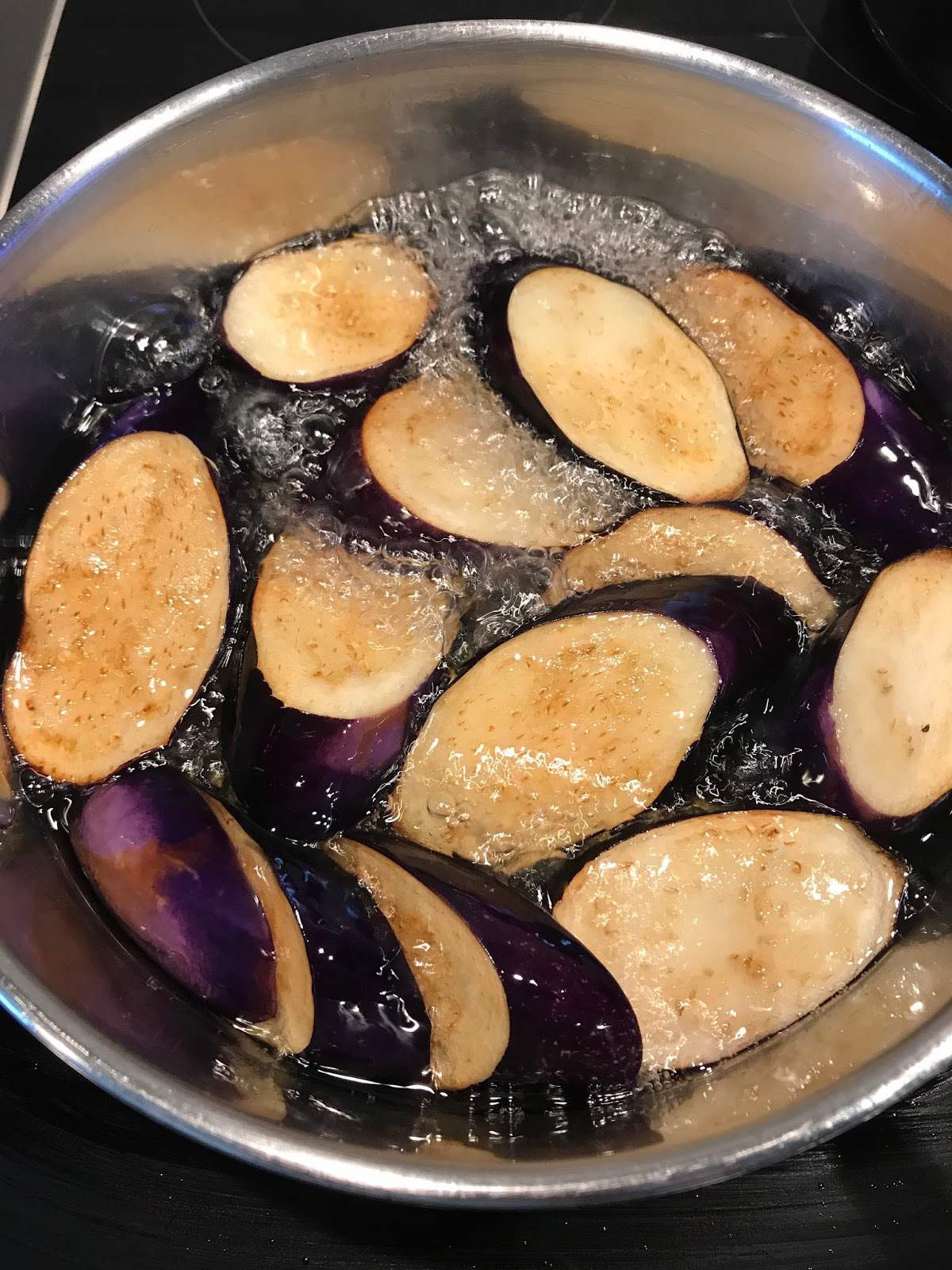
If you don't mind to deep fry at home, this recipe will be an easy, delicious, and fit-for-budget option for your lunch and dinner.  Try to use a wide but deep frying pan to do the "shallow-pan" frying method.  It can fry many eggplant slices at one time without using so much oil.

Whenever I make this dish, I ensure I make a large enough portion to last for two days.  Overnight, the eggplant will become softer and the taste more integrated.  Eating it with a bowl of piping hot rice is happiness.

Other than paprika, you can serve it with scallion, fried shallot, five spice powder, or a dollop of yogurt.


Deep fried Eggplant with Paprika and Sea Salt


Ingredients:
2 Chinese Eggplants
Oil (for deep frying)
Paprika
Sea Salt


How to make it:
1. Rinse the eggplant.  Cut the eggplant into 2cm slices, diagonally.

2. Heat the oil over high heat.  Add eggplant and do not over crowd them.  Fry them until slightly brown on both sides.  Transfer them to paper towel.

3. Sprinkle with paprika and sea salt.  Serve hot or cold.


Saturday, May 27, 2017

Mugwort - the wild edible and recipes |艾草食譜


Mugwort is an aromatic plant that grows widely across both cities and countryside.  If you learn to recognize them, you will be surprised how many of them actually are available around you.

I love the subtle sage-like flavour of mugwort.  Before I learnt foraging, I used to buy packs of dried mugwort leaves to make mochi (a type of Japanese glutenous sweet).  I thought mugwort was some plant that you need to get deep in the wood and normal people would not have the novelty to forage it.  So, after I learnt to recognize mugwort and started to spot them everywhere, I laughed at how silly I was spending money at the shop to buy mugwort.


Mugwort can grow more than six feet tall, and it has either pinkish flowers or light yellow flowers.  However, young mugwort is easy to overlook among other green plants.


Top on the left and underside on the right.


Mugwort’s leaves are greyish-green on the surface, and have sliver wooly hairs on the underside.  Also, some parts of the stem is purple in colour (I didn’t capture that in my photo).  When you rub it very close to the nose, you can smell a light sage-like scent.

Mugwort has an effect on stimulating blood flow around the uterus, and stimulate or ease menstruation.

SO PREGNANT WOMEN MUST NOT HAVE IT!

Many people said that mugwort can enhance vivid dreams.  I’m not sure about that because I always remember my dreams in the morning.  But putting a bunch of dried fragrant mugwort in the bedroom would be a nice idea.

For me, mugwort is a flavoring in dishes.  I use it in soup, dessert, or tea.


Mugwort Salmon Soup


Ingredients:
1 pc Salmon, cut in bite size
1 handful Fresh Mugwort, leaf part only
4 cups Water
1/2 cup Milk
Salt to taste


How to make:
1. In a pot, combine the water and milk.  Bring it to a boil.

2. Add salmon and mugwort.  Continuously boil until the liquid comes back to a rolling boil again. Reduce the heat to medium.

3. Skim off the foam.  Allow it to cook for another 5 minutes. Season it with salt.


Mugwort Panna Cotta


Ingredients:
1 cup Fresh Mugwort, leaf part only
3 cups Whole Milk
1/3 cup Sugar
8 gram Agar Agar
a small pinch of salt


How to make:
1. Combine all the ingredients in a pot.  Bring it to a boil. Reduce the heat to a simmer and let it simmer until the agar agar is totally dissolved; about 20 minutes.

2. Drain and discard the mugwort.  Divide the liquid evenly into the serving containers.  Chill until it is set.


Mugwort Evening Tea


Ingredients:
A small handful of Fresh Mugwort Leaves
Hot Water


How to make:
1. Bring a cup of water to a rolling boil.

2. In a cup, add the washed mugwort.  Pour in the hot water.  Let it steep for about 8 minutes.


Mugwort Mochi (Glutinous Rice Ball


Ingredients: for 4 mochi 
1 big handful of Fresh Mugwort, leaf part only
100 gram Glutinous Flour
150 ml Water
Corn Starch for coating
Red Bean Filling or any type of sweet filling


How to make:
1. To make the mugwort juice, combine the mugwort and water in a pot and bring it to a boil.  Then, reduce the heat to medium-low and boil it for another 5 minutes.  Turn off the heat and let it cool.

2. When the liquid is completely cool, blend it in a food processor. 
Drain and discard the mugwort leaves.  Measure the liquid; you will need about 150 ml for this recipe.  Adjust the liquid with water if it’s needed.


From left to right.

3. Add the glutinous flour into the liquid gradually and mix it with a spoon.  Make sure the mixture has no lump.

4. Cover the bowl with a lid.  Heat up the mixture in the microwave for 45 seconds.  Take it out.  Stir it vigorously with a spoon until it is sticky.  (It should be done in 10 seconds).  Cover the bowl again. Heat up the sticky mixture for another 40 seconds.  Take it out and stir it again.


From clockwise.

5. On a large plate, sprinkle a generous amount of corn starch.  Pour the sticky dough on it.  Coat both sides of the dough with cornstarch to prevent stickiness.  Stretch the dough flat and divide it into 4 equal portions.

6. Press down a piece of dough, and then put a spoonful of filling in the middle.  Wrap up four corners and place the mochi up-side-down.


Saturday, April 29, 2017

Japanese Knotweed - wild edible


Have you seen Japanese knotweed before?  It is a beautiful plant that may remind you of bamboo.  I think it was the reason why knotweed was introduced to North America from Japan as an ornamental plant long time ago.

In Japan and China, people are more focused on the medical benefits of the knotweed.  Knotweed contains a high amount of resveratrol, a potent antioxidant compound that can also be found in red grape skin or blueberry.  I'm not an expert on this one so I can't tell you much about how this organic compound works in our body.

For me, knotweed is a gift from nature and it tastes wonderful.  It has the tangy and subtle sweet flavour that resembles rhubarb.


Knotweed on the left, and horsetail grass on the right

Before I came across Japanese knotweed, I more often encountered horsetail grass, a species that looks very much like knotweed.  However, you can distinguish them very easily. 

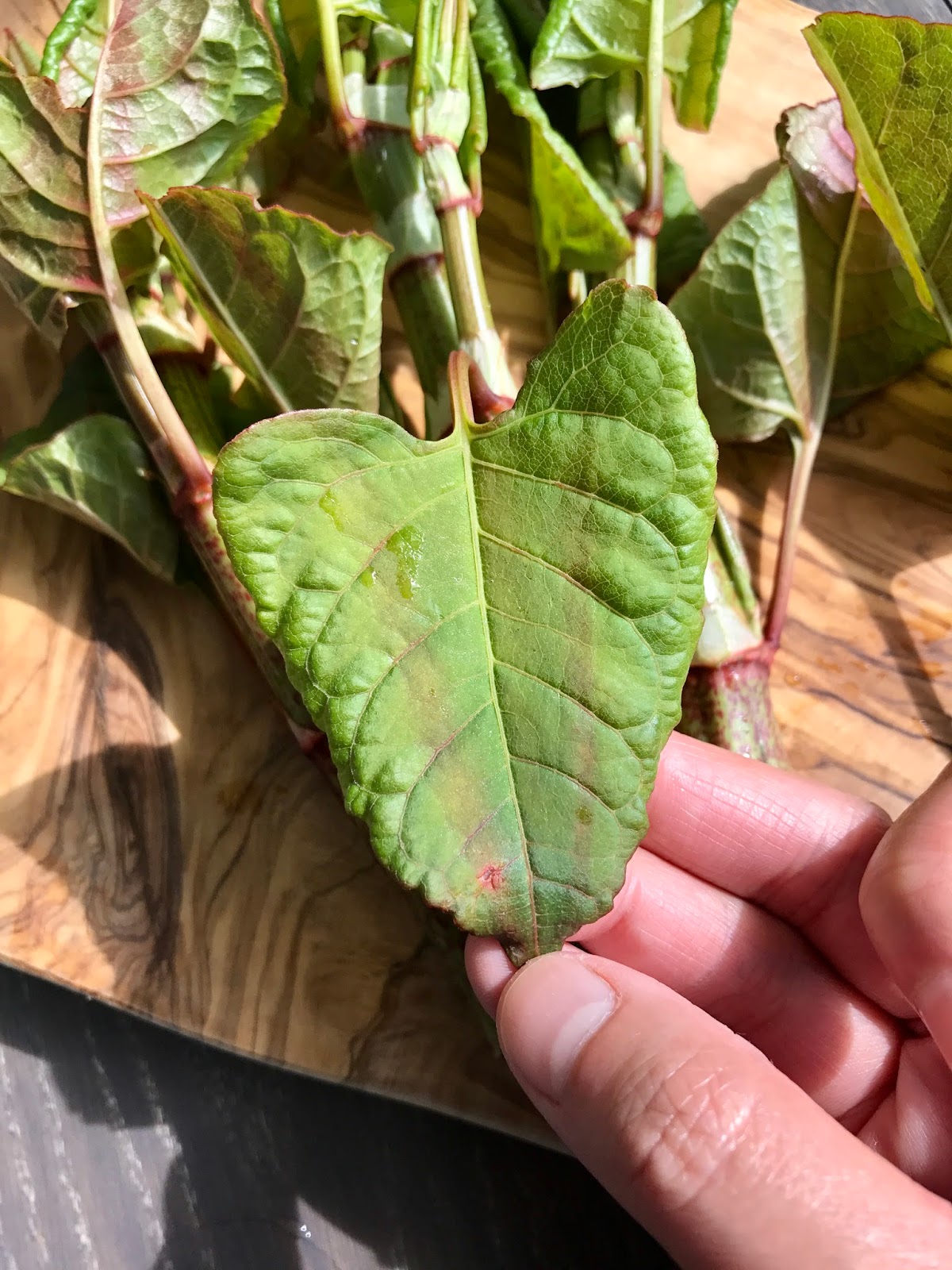
In spring, Japanese knotweed is plump and round, and has reddish purple dots.  The leaves are heart shaped with two subtle purple lines on each.  Horsetail has no spots on the stem, and it has papery texture.  Both species are bamboo-like and invasive; however, knotweed is edible and the other is not.


A young leaf of the Japanese knotweed.  The two lines will subside when the leaf grows more mature.


Knotweed

Young knotweed usually starts to come out in early April.  This fast growing species can grow nearly 10 cm each day up to 3 meters in height, and the root can spread up to 10 feet in depth.  The root system is very vigorous and can even break through concrete, causing much damage in houses or roads.  A strong reason why our Government wants to get rid of it and puts it under the Invasive Special Act.  I think our government has done a very good job because I rarely see knotweed around to forage anymore.
  
When foraging knotweed, we look for the young shoots that are easy to break off and are no more than 6 inches tall. Past this stage, the plants will start to become woody and will no longer be good for consumption.

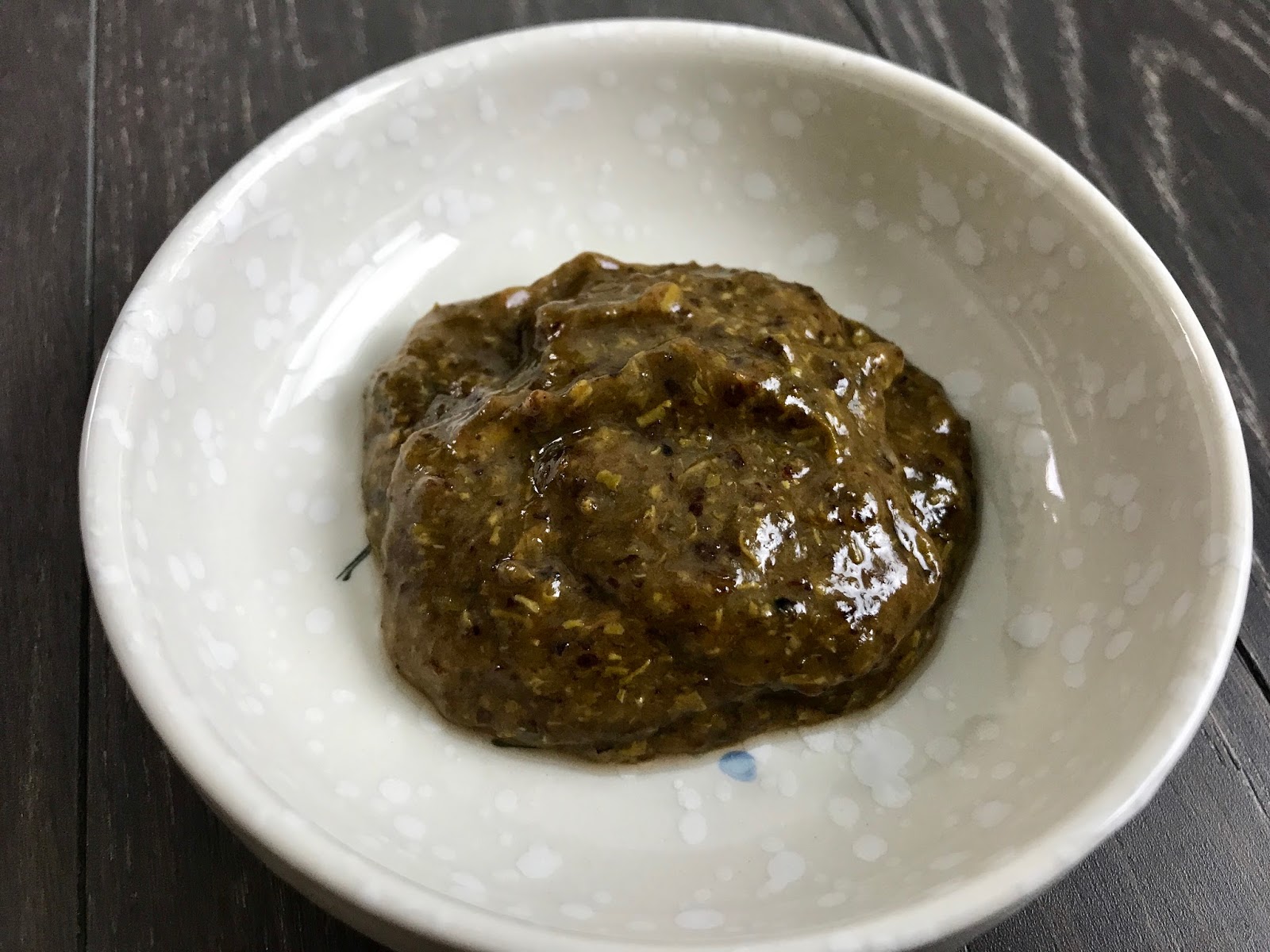
Since Japanese knotweed tastes tangy and sweet, I used it to make some knotweed jam for the yogurt dessert.


Japanese Knotweed Jam

Ingredients:
1/2 cup Young Knotweed Shoots
3 tablespoons Sugar
3 tablespoons Rum Raisin

I infused the raisin three years ago and I only use it for special dessert.  If you don't have some on hand, just use raisin and a splash of rum.  Or just omit the rum.


How to make:
1. Rinse the knotweed carefully; cut it into bite sized pieces.

2. In a non-stick pot, add the knotweed and a cup of water.  Bring it to a boil and cook continuously until the knotweed is totally soft and the liquid has almost evaporated. It takes about 5 minutes.

3. Pour the cooked knotweed in a blender, including the cooking liquid.  Add raisin.  Pulse until the mixture incorporates.


Japanese knotweed Jam


Da, da, da, da~

It is the dessert for tonight.  I must say it feels great to eat the food I forage or grow with my own hands.  There is a bond between the nature and the me inside.


Knotweed jam on greek yogurt, plus some hemp seeds and bean cracker for the garnish.


Roasted Butternut Squash Soup | 烤葫蘆南瓜湯

Compare to the non-roasted version, roasted butternut squash instead brings a tremendous different in the flavour.  The caramelized s...