Showing posts with label wild edible. Show all posts

Wednesday, May 6, 2020

Wild edible - Stir-fried Wild Onion and Pork Belly


Every year, my family will go to forage wild onion in the early May. They grow among the river like grass, but with distinctive onion and garlicky scent. You can substitute the wild onion for leeks to make this dish.


The look of wild onion


Ingredients:
1 bundle off Wild Onion
250 gram Pork Belly
1 tablespoon Chinese Cooking Rice Wine
3 tablespoons Soy Sauce
1/4 taking Salt
1 tablespoon Sugar
2 tablespoons Vegetable Oil

Direction:
1. Cut the pork belong into 1/2 cm slices. Cut the wild onion into sticks. 

2. Heat up vegetable oil over high heat. Add pork belly. Stir fry until it turns colour; about 2 minutes.

3. Drizzle cooking wine and soy sauce. Add sugar and salt. Stir fry untilThe pork belly is nearly cooked, about 3 minutes.

4. Add wild onion. Continue to fry until it is wilted. Turn off the heat and transfer it to a serving plate. 


Garlicky Wintercress Bud Salad


In early May, the wintercress starts to come out and forms flower buds. The wintercress is very tender at this time of the year. If you want to get rid of the bitterness, blanch it in water for about 3 minutes.


The look of wintercress


Ingredients:
1-2 handfuls Wintercresses
3 Garlic Clove
3 tablespoons Soy Sauce
4 tablespoons Vegetable Oil

Direction:
1. Peel the garlic. Chop it into fine pieces.

2. Bring a pot of water to a boil over high heat. Add wintercresses. Boil until they are soften; about 2-3 minutes.  Drain and transfer them onto the serving plate.

3. Top the chopped garlic on the wintercresses.

4. Heat up the vegetable oil. Drizzle over the garlic to make it fragrant.


Monday, April 20, 2020

Wild Garlic and King Mushroom Stir fried


A few year ago, my family and I went for a hike and accidentally found a large patch of wild garlic. Although I call them wild garlic, they are not the type of wild garlic that with a single glossy board leaf. But they smell and taste just exactly like garlic. It was the distinct smell that had me found them back then. I believe the ones I discovered are actually domestic garlic. But somehow they grow and spread in the wild. So now, we come to pick these delicious wild garlic as our annual spring activity.

Treating these wild garlic as garlic shoots you can purchase at supermarket, you can stir fry and make soup with them.

INGREDIENTS:
2 handfuls Wild Garlic
4 King Mushrooms
1 teaspoon Sugar
1/2 teaspoon Salt
1 tablespoon Chinese Cooking Rice Wine
3 tablespoons Vegetable Oil

DIRECTION:
1. Cut the wild garlic into about 4 cm long; cut king mushrooms into small chunks.

2. Heat up oil over high heat. Add mushrooms and stir fry for 3 minutes.

3. Add wild garlic. Stir fry for about a minute.  Drizzle over the cooking wine. Add salt and sugar. Stir well. Turn off the heat.


Wild Dandelion Salad with Honey Balsamic Vinaigrette Dressing 蒲公英沙律


Dandelion is coming back. While many people may not like to see these popping yellow flowers, my husband and I are very happy to welcome them back with open arms. We miss the flavour. The mildly bitter leaves with the sweet balsamic vinaigrette. And the bright yellow flower petals that are so delicious in cookies. We just never have enough of dandelion.

INGREDIENTS:
1-2 cups Dandelion Leaves
3 tablespoons Balsamic Vinegar
2 tablespoons Olive Oil
1 tablespoon Honey

DIRECTION:
1. Rinse the dandelion; drain well.

2. Whisk together balsamic vinegar, olive oil, and honey. Add dandelion leaves; gently mix together. Serve immediately.


Scrambled Egg with Fiddle Head and Spring Wild Green


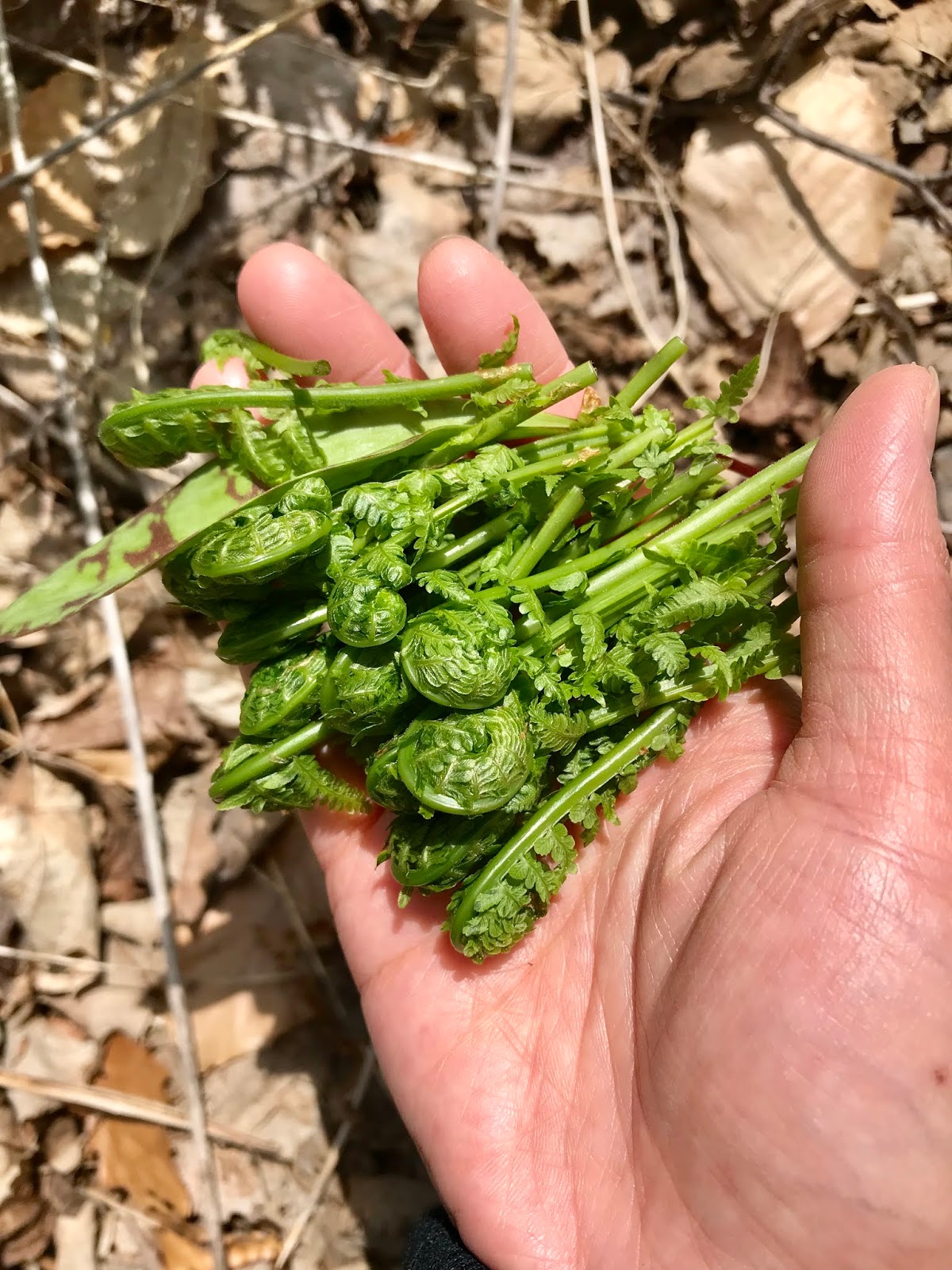
Spring finally comes. We can finally forage the delicate greens and add them into our diet. This week, we found fiddle heads, curly dock, and trout lily. Fiddle head is sweet, curly dock is slightly sour, and trout lily is green. I put them all into this scrambled egg and make it into a big breakfast for the family.


Curly dock

The left side is fiddle heads, and the right side is trout lily.

INGREDIENTS:
Wild Edible Spring Green (Fiddle head, trout lily, and curly dock)
6 Eggs
1/4 teaspoon Salt
1/4 teaspoon Sugar
3 tablespoons Vegetable Oil

DIRECTION:
1. Whisk the eggs, salt and sugar together.

2. Bring a small pot of water to a boil over high heat. Add fiddle heads. Blanch them for about 5 minutes to get rid of the bitter taste. Drain well.

3. Heat up the oil over high heat. Add the wild greens and stir fry for about 30 seconds. Add the egg. Keep stir frying until the egg coagulates. Turn off the heat.


Spring greens army son's flavourite.


Stir fried Fiddle Head in Butter Sauce


It is spring. It means the fiddle head are coming out. On one of the hike, we found an area where full of fiddle heads. We keep the place as our secret to protect the resource. When picking fiddle heads, look for the ones still close tightly. And you will never want to pick out the whole plant or the clean out the whole area, if you want to come back for the same spot every year.

Fiddle head is tender and sweet. It is the beast wild green I'd ever tasted, and it is still on the top of the favourite wild edible list among my family. Cooking fiddle head doesn't need to be complicated. Instead, the simplest, the better. However, blenching it prior is essential for getting rid of the bitter taste.

Hope you enjoy this spring recipe.

Look for the fiddle heads are still closing tightly. As they open up, they become poisonous and are no longer safe for eating. 

INGREDIENTS:
1-2 handfuls Fiddle Heads
2 tablespoons Butter
Salt to taste


DIRECTION:
1. Bring a small pot of water to a boil over high heat. Add fiddle heads. Boil them for about 5 minutes. Drain well.

2. Heat up the butter. Add blenched fiddle heads. Fry until they are wilted; about 5 minutes. Season with salt to taste.


Mugwort Dumpling Red Bean Soup 艾草紅豆甜湯


Around Mid May, you will start to find mugwort growing on the road sides or among bushes. My husband and I like to pick a bunch whenever we see it. It has a unique fragrance that you won't forget once you smell it once. It is popular to use this wild edible plant to make into the chewy glutinous dumplings and serve them with sweet bean soup.

INGREDIENTS:
1 cup (packed) Mugwort, young leaves only
1/4 teaspoon Baking Soda
1 cup Glutinous Flour
1/2 cup Water
1 pack Red Bean Paste (store bought)

DIRECTION:
1. Pick the young leaves off the stems; rinse off the dirt.


2. Bring a pot of water to a boil over high heat. Add baking soda and mugwort. Boil until the mugwort soften; about 5 minutes. Drain well.


3. In a processor, add the cooked mugwort and about 1/2 cup of water. Blend until the mugwort is totally smooth.


4. In a mixing bowl, add the glutinous flour. Slowly add half of the mugwort liquid into the flour. Mix until it becomes dough. If it is too dry, add more mugwort liquid. The texture of the dough should feel like an ear lobe.


5. Set a large pot of water to a boil over high heat. When it comes to a rolling boil, roll a small portion of dough into a ball. Add it to the water. Repeat the process until all the dough is gone.


6. When the boiled dumplings float to the surface, it means they are done. Scoop them out and place them in cold water to stop the cooking process.


7. In a small pot, add the bean paste and some water. Stir and cook over medium heat until the paste is diluted into soup. No need to add sugar. It should be sweet enough.

8. Divide the soup into small bowls. In each bowl, add 6-8 mugwort 
dumplings. 


Friday, March 6, 2020

Pine Tip Rub Pork Belly 松尖豬腩肉


Pine tip is a very good seasoning; it has the mix of citrus and gin flavour that goes well with pork and fish. Prior to the picking, you will want to do a little taste test around different trees, looking for one that produces the great citrus flavour. I had some great pine tips before, but I also had some were equally bad. Just try a few different trees to do a comparison. My son and I enjoy nippling the trees while taking a walk. He always knows the pine tips is a source of vitamin C and he is so proud of himself for eating them. Personally, I like the tips are still with the brown casings, just because they look the freshest to me. But it is totally fine if they are without the case too. 


Pine tips in their casing.

INGREDIENTS:
20 Pine Tips
1 pc Pork Belly, cut into chunks
4 tablespoons Soy Sauce
1/3 teaspoon Salt
2 tablespoons Sugar
1 teaspoon White Pepper Powder
3 tablespoons Vegetable Oil
Honey (for serving)

DIRECTION:
1. Remove the brown casings from the pine tips. Chop the pine tips until fine.


2. In a mixing bowl, combine all ingredients except the oil. Rub the pork bell until it is well coated with the seasoning; marinade it for 30 minutes.


3. Heat up the oil in a skillet. Place the pork belly on top; fry it until golden brown over medium heat; about 10 minutes.


4. Turn the pork over, and fry the other side for another 10 minutes. Transfer the pork on a serving plate. Brush a think layer of honey on top before serve.


Thursday, March 5, 2020

Japanese Knotweed with Cambozola Cheese and Honey


Japanese knotweed is a wild edible vegetable that has a slightly sour taste. You have to pick them when they are still less than 10 cm long or before they turn woody. Young knotweed is very tender and is best to serve raw on cheese with a drizzle of honey. 


The knotweed stood among the dried leaves.

They somewhat look like asparagus.


Tuesday, July 9, 2019

Pine Tip Mayonnaise Dip


They are called pine tips, but they actually grow from fir trees instead of pine.  Pine tip is one of the delicious wild edibles my son enjoys eating.  Every spring when the bright green pine firs start to emerge from their brown and papery skins, we are excited.  Before collecting pine tips, you should give it a taste test to see if you like the flavour.  While many people like that citrus and piney flavour, some others find it too strong or bitter.  And the taste of pine tips can be very different from tree to tree.  Try to look for the tips that are still half wrapped inside the brownish case.

This recipe is dead simple that I actually don't even think it is necessary to write an article.  However, it is a tasty recipe and everyone likes tasty food.  So, I believe there is a need to share this delicious gift from Mother Nature.

We eat this pine tip mayonnaise as a dip with vegetable sticks or French fries, but it is also tasty to serve as a spread on ham sandwich. 

INGREDIENTS:
1 Cup Mayonnaise (I used full fat)
12-15 Pine Tips
1 tablespoon Sugar
1/8 teaspoon Salt

DIRECTION:

1. Soak the pine tips in water to remove the papery case; drain well.  Finely chop the pine tips.

2. In a mixing bowl, combine all ingredients together and mix thoroughly.  It can be serve as a dip or sandwich spread.


Friday, April 19, 2019

Pine Tip Vinegar | 嫩松葉尖浸醋


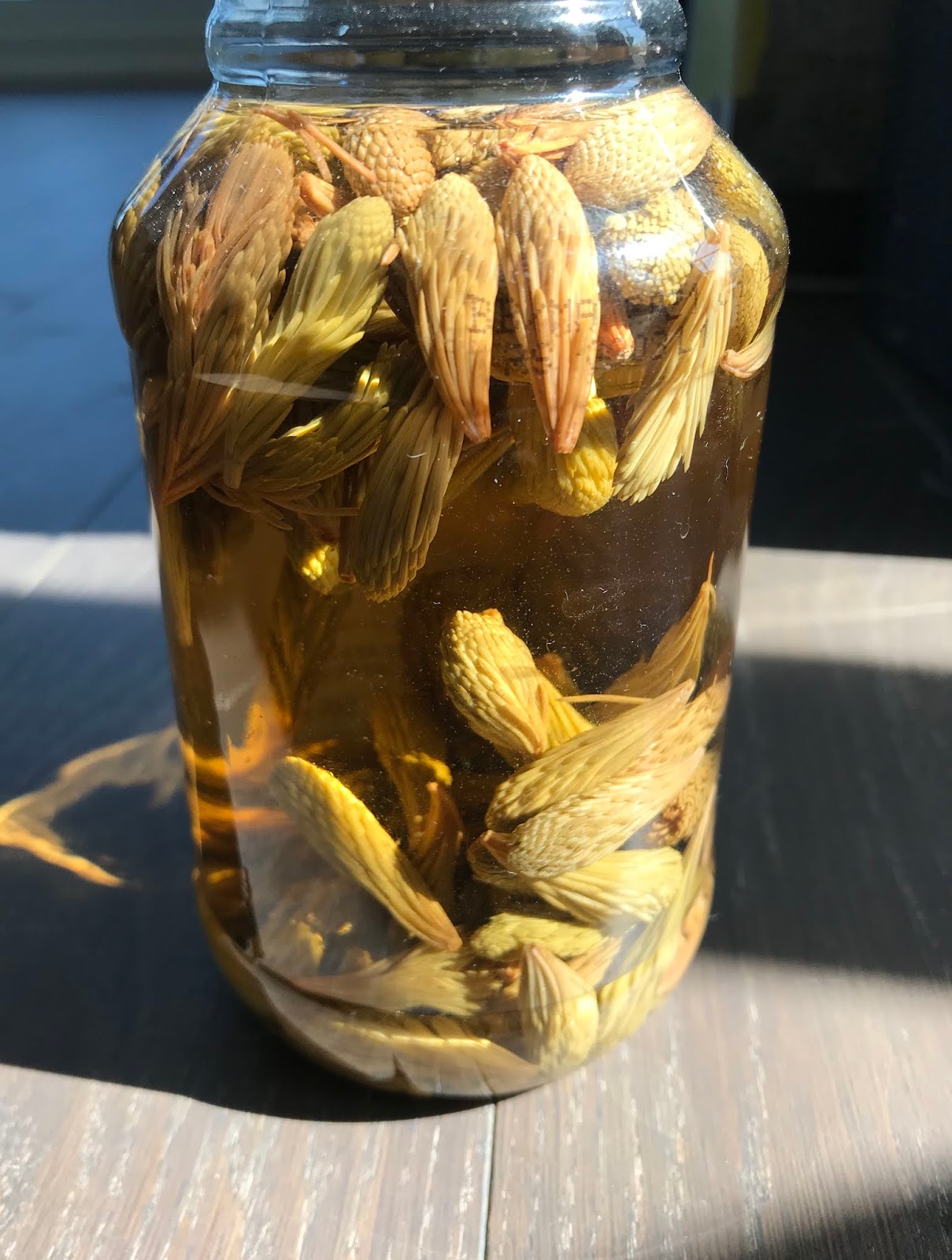
Spring is the time to pick the young green pine tips.  They are the sprouts of the new branches.  Try to take one and nibble.  You will find it tastes like citrus.

Our family likes to add the pine tips directly into salad green, or chop them up to mix it with mayonnaise.  But I use pine tip vinegar the most.  I use it for salad dressing, marinade, or even for adding to my Chinese noodles snack.

Just like any vinegar, this vinegar seems to last forever! Each year I make two large bottles and they still taste great until the end of the year when I use up the last drop of them.  Though, the longer the tips sit in the vinegar, the browner the vinegar will become.  So don't be alarmed.  I hope you enjoy this spring flavour.


INGREDIENTS:
Young Pine Tips, about 20-30 pcs
1-2 cups White Wine Vinegar

DIRECTION:
1. Rinse the fresh pine tips with cold water; drain well.

2. In a large mason jar, add the pine tips.  Pour vinegar until the pine tips are completely submerged.  Store it in the pantry for at least a month before using it.


Thursday, September 27, 2018

How to make acorn flour


The Autumn has arrived!  It is our favourite season of the year because there are so many things you can forage in the woods - autumn olives, apples, pear, and ACORNS!  We love acorn more than any other nuts.  It has a deeply earthy flavour that is between pecan and walnut.  We use it to make cookies.


This year the acorns grow much better than the last two years.  We got plenty of them so that we can have enough to make cookies and soup.


We pick acorns in the woods.


We also collect the acorns on the roadside in the city.


The recently dropped acorns are the best because they are less likely to have worms and contain higher fat content.  Of course, the flavour is also stronger.


We need to do a float test for the acorns.  Fill a sink of water and add the acorns.  The good acorns will sink and the bad acorns will float.


Crack the nuts and remove the shells.  Put the flesh in a jar of cold water.


Continue to soak the flesh in the water for two days in order to leach out the tannin.  You will find the water turns slightly brown and it is the tannin that causes bitterness.  Change the water twice a day.


Put the flesh in a blender with some fresh water.  Process it until really fine.  Pour the mixture over a tea towel and squeeze out the milky liquid.  While holding the tea towel tightly, rinse and squeeze the processed acorn meal under running water until the liquid runs clear.


Add the acorn meal to a non-stick pan.  Toast over low heat until it is totally dried.  


Store the acorn flour in a ziplock bag and keep it in the freezer for later use.


Thursday, July 12, 2018

June Berry Muffins with Lemon and Cardamom


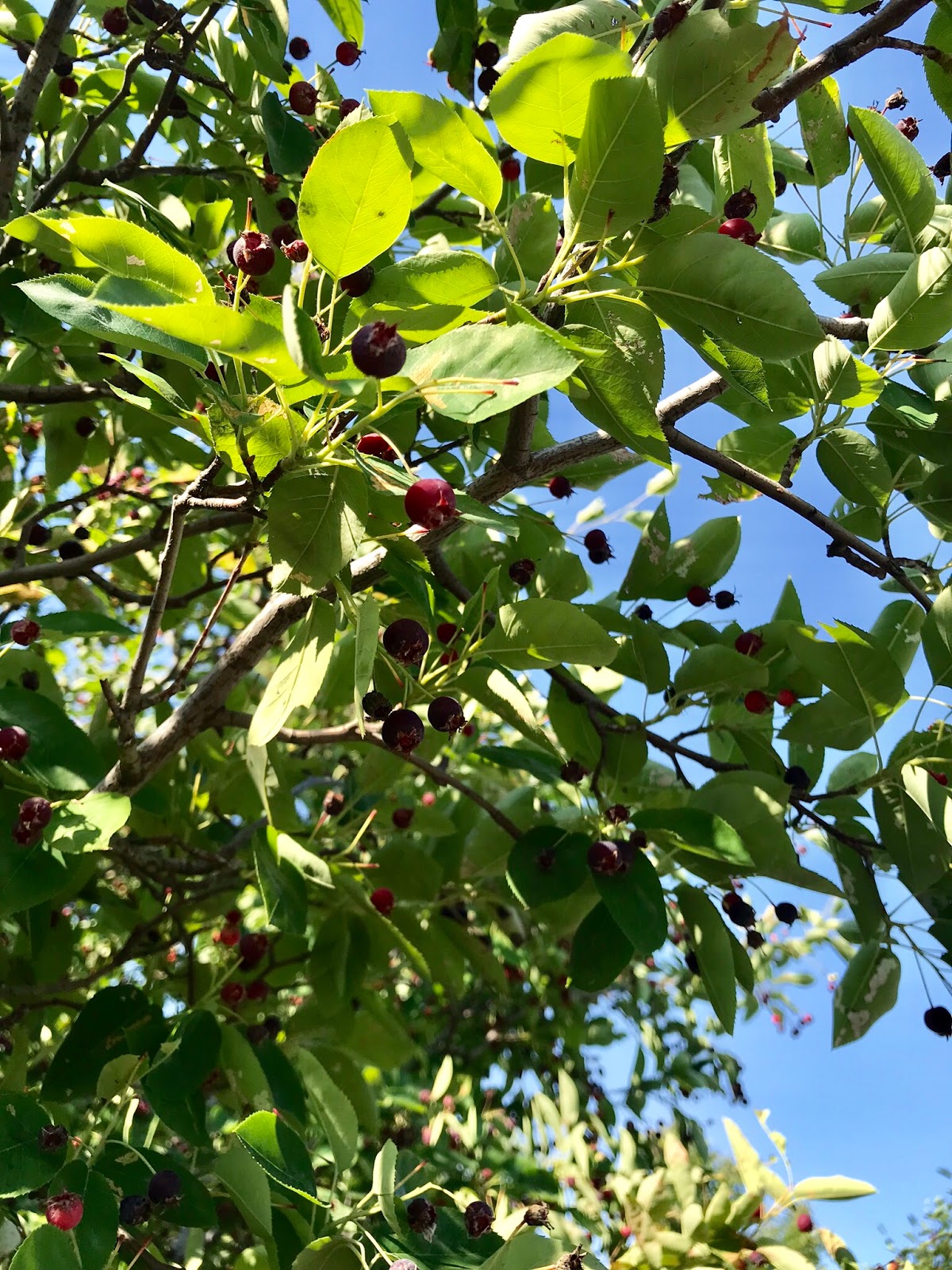
June berries are also called service berries.  We are so lucky to have many of them grow at the park across the street.  When it comes to mid-June, the berries will become purplish-red and attract many birds to eat them.


My son is familiar with these little tiny juicy berries and he knows exactly which trees in the park produce the best berries.  He often suggests to pick some berries on the way home to add into pancakes or muffins, but he usually ends up snacking on them instead of bringing them home.  Now, eating June berries is a highlight for my son in the summer after he plays at the splash pad at the park.


Actually June berries are a very common botanical plant in Toronto.  If you pay attention, you will certainly come across them in parks, gardens, or sidewalks.

I froze the June berries before I used them for the recipe here.  It is only because I didn't have time to make the muffins for that few days and I didn't want them to go bad.  However, fresh berries are equally good.


INGREDIENTS:
1 cup June Berries, frozen
1 cup Cornmeal
2 cups All Purpose Flour
2 teaspoons Baking Powder
1/2 cup Brown Sugar
1 handful of Quinoa (optional)
3 Eggs, beaten
1/2 cup Butter, melted
1 cup Milk, 2%
1 Lemon, zest and juice
2 teaspoons Cardamom, ground
1 teaspoon Ground Ginger
pinch of Salt

材料:
1 杯  Juneberries,冷凍
1 杯  玉米粉
2 杯  麵粉
2 茶匙  泡打粉
1/2 杯  棕糖
一把  藜麥 (隨意)
3 隻  雞蛋,打勻
1/2 杯  牛油,熱溶
1 個  檸檬,皮和汁
2 茶匙   豆蔻粉
1 茶匙  薑粉
少撮  鹽


DIRECTION:
1. Preheat the oven at 360F.

2. In a large bowl,combine butter, eggs, milk, lemon juice and zest together; mix well.

3. Add in cornmeal, flour, quinoa, cardamom, ground ginger, brown sugar, baking powder, and salt.  Mix everything thoroughly into batter.

4. Gently stir in the frozen June berries.  Divide the batter equally into the paper muffin cups.  Bake for about 20 minutes.

做法:
1. 預熱焗爐至360F。

2. 在一只大碗內,加入牛油、蛋、檸檬汁和皮;拌勻。

3. 下玉米粉、麵粉、藜麥、薑粉、棕糖、泡打粉,鹽;拌勻成麵糊。

4. 輕輕拌入Juneberries。把麵糊平均倒入小蛋糕模。焗若20分鐘。


Tuesday, July 10, 2018

Milkweed Plant Dinner | 乳草 (馬利勒) 晚餐


Milkweed is the type of weed you can eat most of the year.  We can go after the shoots in April, flower buds and young leaves in June, the fragrant flowers in July, and the seed pods in late August.  All parts are so tasty that you will wonder why no people decide to farm milkweed to sell.


Collecting milkweed at a park in the heat wave.

I learnt to eat milkweed from a person I knew through Instagram a year ago.  She is a herbalist and also a forager.  Somehow she saw a photo of a milkweed pod I posted on Instagram to ask if anyone knew if it was edible.  She sent a private message to me with a long story of how her people back home in Brazil consider milkweed as a common type of vegetable.  The message also came with the elaborate recipes she enjoyed cooking.

I started to message this lady here and there to talk about different foraging plants we learn in two different countries.  I never knew that you could make a friend to share the same hobby just like that.  Though, I of course did not go to try milkweed just because she said it was safe.  Eating the wrong plant can be fetal.


Milkweed buds and flowers.  Flowers are fragrant and taste very sweet when eaten raw.

Since then, I did lots of research on this plant.  I meant, really a lot, in both English and Chinese.  Half of the information says milkweed was poisonous, but the other half was saying it is edible.  I was confused.

Later, I started to ask around and eventually I found a person who knew this plant well.  Then, I looked up a few reliable foraging guide books before I gave it a try.  I still remember the feeling when I tried the first small milkweed seed pod - part of me was excited about this new found, but the other part of me was so terrified that I would have food poisoning.  I think it is kind of the feeling when people eat puffer fish sashimi.

Milkweed buds taste like asparagus after they are cooked.  The flowers taste sweet and floral, and are slightly stronger than rose in my opinion.  The seed pods also taste very similar to asparagus to me but with a different texture.

Long story short, now milkweed has become one of the wild edible plants I enjoy the most.  But to be clear, I've only cooked it for my husband and myself thus far, and I've never fed it to my little boy. I am still learning this plant and am not sure how the little body can digest it.

Below are the recipes I usually prepare with milkweed in the summer time.  I hope you enjoy it.


Pickled Milkweed Buds

INGREDIENTS:
1-2 Flower Buds
2 tablespoons White Wine Vinegar
2 tablespoons Water
1 teaspoon Sugar
pinch of Sea Salt

DIRECTRION:
1. Combine all ingredients together.  Leave it in the fridge over night before use.


Blanched Milkweed

INGREDIENTS:
Milkweed Buds (Both green and red are fine)
Water
Salt

DIRECTION:
1. Bring a pot of water to a boil.  Add milkweed buds.  Boil them until slightly soft; about 2 minutes. Drain well.


For the balsamic rib Recipe, please go to One Pot Sticky Balsamic Rosemary Ribs


Roasted Butternut Squash Soup | 烤葫蘆南瓜湯

Compare to the non-roasted version, roasted butternut squash instead brings a tremendous different in the flavour.  The caramelized s...