Showing posts with label Japanese. Show all posts

Monday, April 20, 2020

Chinese Marinated Spinach 中式涼拌菠菜


Spinach is inexpensive and nutritious so I cook it quite often. This recipe is one of them. It makes a wonderful side dish in summer time, accompanying a bowl of steamed rice. The seasoning below is just a guideline; adjust it if needed.

INGREDIENST:
A bundle of Spinach
4 tablespoons Soy Sauce
2 tablespoons Mirin
2 tablespoons Sesame Oil
1 teaspoon Sesame Seeds

DIRECTION:
1. Bring a large pot of water to a boil over high heat. Add Spinach in a few batches. Boil until the spinach just wilted; about 1 minute. Submerge the spinach in the cold water to stop the cooking process.

2. Squeeze out the excess water from the spinach in a few batches. Place it in a mixing bowl.

3. Add the remaining ingredients. With hand, Mix until the spinach is coated with the sauce. It is ready. Serve it with steamed rice.


Tuesday, October 1, 2019

慢煮蒟蒻 Slow Cooked Konnyaku in Soy


INGREDIENTS:
2 pcs Konnyaku (Konjac)
15 Fresh Shiitake Mushrooms
1/4 cup Soy Sauce
3 tablespoons Sugar
3 tablespoons Chinese Cooking Rice Wine
1 cup Water

DIRECTION:

1. With a spoon, cut the konnyaku into bite size.  Cut the mushrooms into thick pieces.

2. Set a small pot of water to a boil.  Add the konnyaku bits and boil them for 5 minutes over high heat; drain.

3. In the same pot, add seasoning and konnyaku; mix well.  Let it cook over low heat until the sauce is thicken and it is ready.  It can be store in the fridge up to a week.

Thursday, September 6, 2018

Konnyaku and Enoki Salad with Sweet Miso Dressing | 蒟蒻金菇湯律味噌汁


Konnyaku is made of konjac, a type of yam that is high in dietary fibre with nearly zero cholesterol.  Konnyaku has little taste and it has a jiggly texture like jello.  You can usually see konnyaku in white or grey colour like the one in the photo below.  The white one is the original flavour and the grey one is added with seaweed.  My family found the seaweed version more delicious so I usually just buy the grey one.


Enoki mushrooms taste sweet when eaten raw; it pairs so well with the umami flavour of the miso dressing.  This miso dressing can go well with many leafy greens so please feel free to substitute the rest of the ingredients for other vegetables on hand.


INGREDIENTS: 4 servings
1 pack Konnyaku
2 packs Enoki Mushrooms
2 Heirloom Carrots, peeled, cut into sticks
8 Cherry Tomatoes
1/2 Green Lettuce, rinsed and torn into bite size
2 Mini Cucumber, cut into bite size
1 bunch Coriander, leaves only, roughly chopped

DRESSING:
3 tablespoon White Sesame, toasted and slightly ground
2 tablespoons Miso Paste
2 tablespoon Rice Vinegar
1 tablespoon Sesame Oil
1 tablespoon Sugar

材料:4人份
1 塊  蒟蒻
2 束  金菇
2 條  蘿蔔,去皮,切條
8 粒  車厘茄
1/2 棵  生菜,洗淨,撕成小塊
2 條  小黃瓜,切大粒
1 束  莞茜,葉部份,切碎

汁料:
3 湯匙  白芝麻,烤香,磨碎
2 湯匙  味噌
2 湯匙  米醋
1 湯匙  芝麻油
1 湯匙  糖


DIRECTION:
1. Bring a small pot of water and a teaspoon of salt to a boil.  Add konnyaku and boil it for 2 minutes; drain well.  Cut the konnyaku into bite size; set them aside.

2. Cut off and discard the root of the enoki mushrooms.  Cut the enoki mushrooms in half.

3. In a mixing bowl, add all salad ingredients and toss them to combine.

4. In a small mixing bowl, whisk together the dressing ingredients until it is smooth.  Drizzle it over the salad green before serving it.

做法
1. 燒熱一小鍋水和一茶匙鹽。下蒟蒻,煮若2分鐘;取出,切成小粒,備用。

2. 切去金菇底部;把金菇切成兩半。

3. 在一只大碗內,加入所有沙律材料;拌勻。

4. 在另一只小碗內,加入所有沙律汁材料;拌至幼滑。淋上沙律食用。


Friday, January 5, 2018

Dango in Red Bean Sweet Soup | 豆腐丸子紅豆湯


INGREDIENTS:
Red Bean Soup, link
50 gram Silken Tofu
100 gram Glutinous Flour

DIRECTION:
1. Mix the tofu with glutinous flour together until the texture resembles to an earlobe.

2. Roll the dough into many event size balls.  Boil them in rolling boiling water until they float onto the surface.  Scoop them up and add them to the hot red bean soup. 


Sunday, November 12, 2017

Sweet Potato Cake Roll | 甘薯蛋卷


I sometimes wonder if other people cannot resist to buy sweet potatoes just like me.  Most of the time I really don't have any plan for them when I buy them.  They are just adorable.  This recipe is one of the best ways to turn this humble root vegetable into some beautiful looking dessert, while still keeping its rustic flavour.


Sweet Potato Cake Roll | 甘薯蛋卷

Ingredients for Sweet Potato Filling:
300 gram Sweet Potato, thinly sliced
1/4 cup Brown Sugar (Add more if you have a sweet tooth)
2 gram Agar Agar Powder (Usually available in big Asian supermarkets)
100 ml Hot Water

Ingredients for Cake Wrap:
70 gram All Purpose Flour
2 Eggs
60 gram Icing Sugar
1/2 teaspoon Baking Powder


甘著餡材料
300 克   黃蕃薯,切薄片
1/4 杯   黃糖 (嚐甜者可加多一些)
2 克   寒天粉 (一般在大型亞洲超市可找到)
100 毫升   熱水


蛋糕外皮材料:
70 克   麵粉
2 隻   雞蛋
60 克   糖霜
1/2 茶匙   泡打粉


DIRECTION:

Tuesday, July 4, 2017

Mitarashi Tofu Dango (Tofu Glutinous Balls with Sweet-Salty Sauce) | 豆腐丸子


Tofu dango is a Japanese dumpling snack made of tofu and mochiko, a type of glutinous short grain Japanese rice flour.

Dango is chewy and soft with a depth of soy flavour.  When served, three or four dango are often put on a skewer and coated with the sweet-salty sauce, mitarashi.  

The first time when I ate dango was in Japan travelling with my family.  There was a small store selling concessions and tea for the tours at the park, and I saw a man speedily rolling a big piece of dough into many small balls and into a boiling water pot.  An old lady beside him scooped up the floating rice balls with a strainer.  Then she started to skewer those piping hot dumplings.  I still remember how crazily exited I was when I finally got my first chance to eat the "Japanese dumpling".  Since I spoke no Japanese, I used my body language to place my order for the snack.  The old lady held a few skewered dumplings in hand and dipped them into a pot of "brownish sauce" (as I called it back then).  That was the mitarashi dango.  The flavour was awesomely comforting, and I fell in love with this sweet and salty snack since then.


For me, dango is very similar to the Chinese "tang yuen".  Both snacks are soft, chewy, and can be served sweet or savoury, and they are also made of glutinous short grain rice flour.  The big difference was that dango is using Japanese rice while "tang yuen" uses Chinese rice.

At home, I use both in my dango making, depending on which one is on hand.  Although mochiko can be easily found in many Asian markets, it is not as widely available as Chinese glutinous rice flour.  Also, mochiko is more pricy.  However, the dumplings that are made of mochiko are finer and softer in texture, which makes the dessert more delicate and I enjoy it more.

To use tofu instead of water to form the dough which can increase the nutritional value while adding extra flavour for the dumplings.  You can use silken or firm tofu to make this dessert, but the silken version will for sure be the winner when comparing texture.

Thanks for stopping by.  I hope you enjoy this recipe.


Tofu Dango
豆腐丸子


INGREDIENTS:
90 gram Silken Tofu
120 gram Glutinous Flour


Mitarashi Sauce:
4 tablespoons Soy Sauce
2 tablespoons Mirin
2 tablespoons Sugar
1 tablespoon Water
1 teaspoon Corn Starch


DIRECTION:
1. In a mixing bowl, mash the tofu until fine with a hand.

2. Add flour, a little at a time, mixing it with the tofu and form it into a dough.  The texture of the dough should resemble the softness of the earlobes.  Add more flour or tofu to adjust the texture if needed.


3. Bring a pot of water to a rolling boil over high heat.  Roll the dough into equal sized balls.  Add the balls to the water.  Boil them until they float to the surface which indicates that they are cooked through.

4. Scoop out the dumplings and quickly transfer them into a bowl of cold water to stop the cooking process.


5. Put three or four dumplings on a skewer and place them on a serving place.  Set aside.


6. To make the mitarashi sauce, combine soy sauce, sugar, and mirin in a saucepan.  Gently heat it up over low heat.

7. Combine cornstarch with a tablespoon of water.  Then whisk it into the soy sauce mixture.  Continuously stir the sauce until it thickens.  Use a spoon to draw a line in the saucepan, if the sauce separates it is done.  Remove it from the heat and spoon it over the dumplings immediately.


Saturday, April 29, 2017

Japanese Knotweed - wild edible


Have you seen Japanese knotweed before?  It is a beautiful plant that may remind you of bamboo.  I think it was the reason why knotweed was introduced to North America from Japan as an ornamental plant long time ago.

In Japan and China, people are more focused on the medical benefits of the knotweed.  Knotweed contains a high amount of resveratrol, a potent antioxidant compound that can also be found in red grape skin or blueberry.  I'm not an expert on this one so I can't tell you much about how this organic compound works in our body.

For me, knotweed is a gift from nature and it tastes wonderful.  It has the tangy and subtle sweet flavour that resembles rhubarb.


Knotweed on the left, and horsetail grass on the right

Before I came across Japanese knotweed, I more often encountered horsetail grass, a species that looks very much like knotweed.  However, you can distinguish them very easily. 

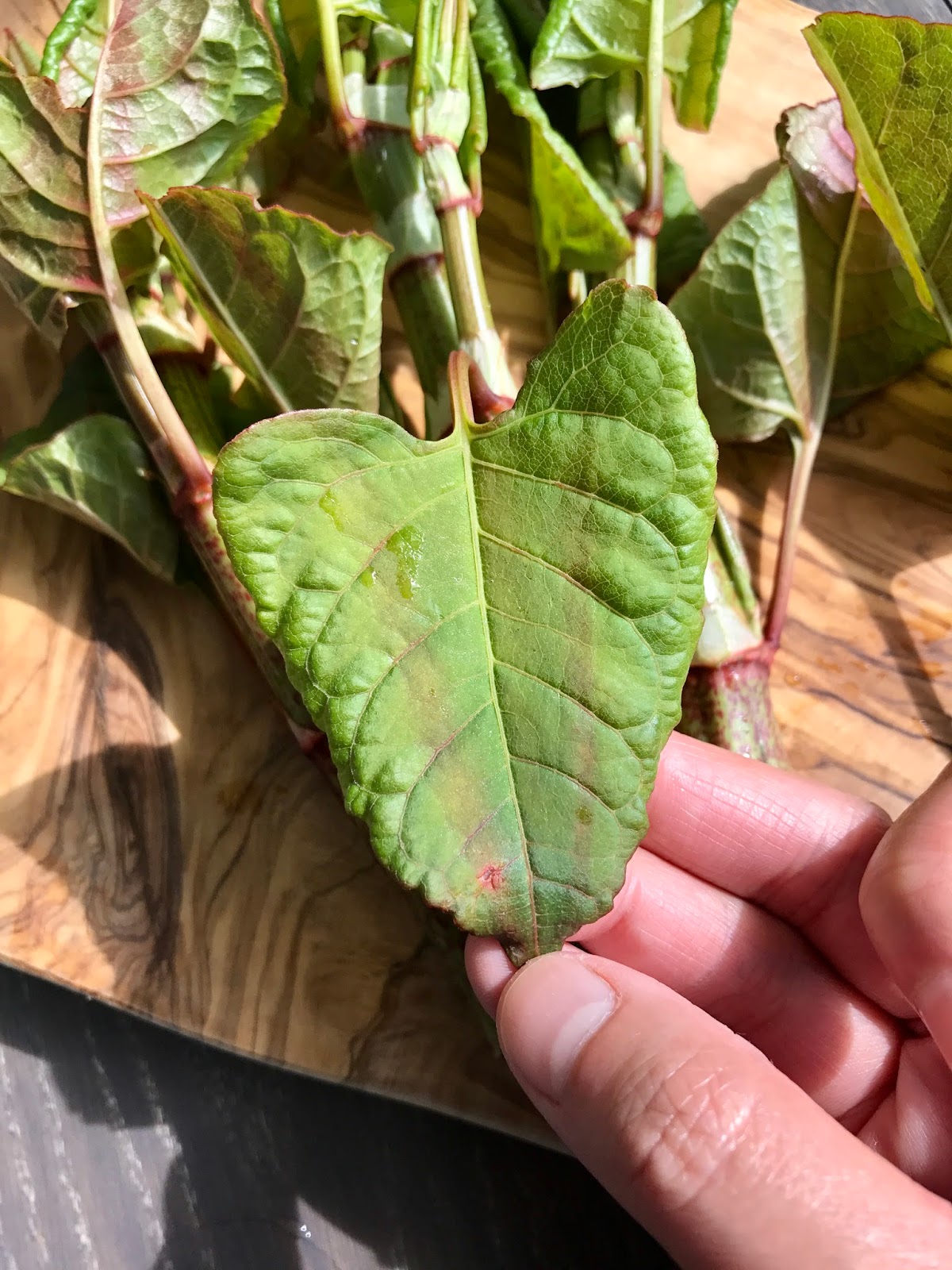
In spring, Japanese knotweed is plump and round, and has reddish purple dots.  The leaves are heart shaped with two subtle purple lines on each.  Horsetail has no spots on the stem, and it has papery texture.  Both species are bamboo-like and invasive; however, knotweed is edible and the other is not.


A young leaf of the Japanese knotweed.  The two lines will subside when the leaf grows more mature.


Knotweed

Young knotweed usually starts to come out in early April.  This fast growing species can grow nearly 10 cm each day up to 3 meters in height, and the root can spread up to 10 feet in depth.  The root system is very vigorous and can even break through concrete, causing much damage in houses or roads.  A strong reason why our Government wants to get rid of it and puts it under the Invasive Special Act.  I think our government has done a very good job because I rarely see knotweed around to forage anymore.
  
When foraging knotweed, we look for the young shoots that are easy to break off and are no more than 6 inches tall. Past this stage, the plants will start to become woody and will no longer be good for consumption.

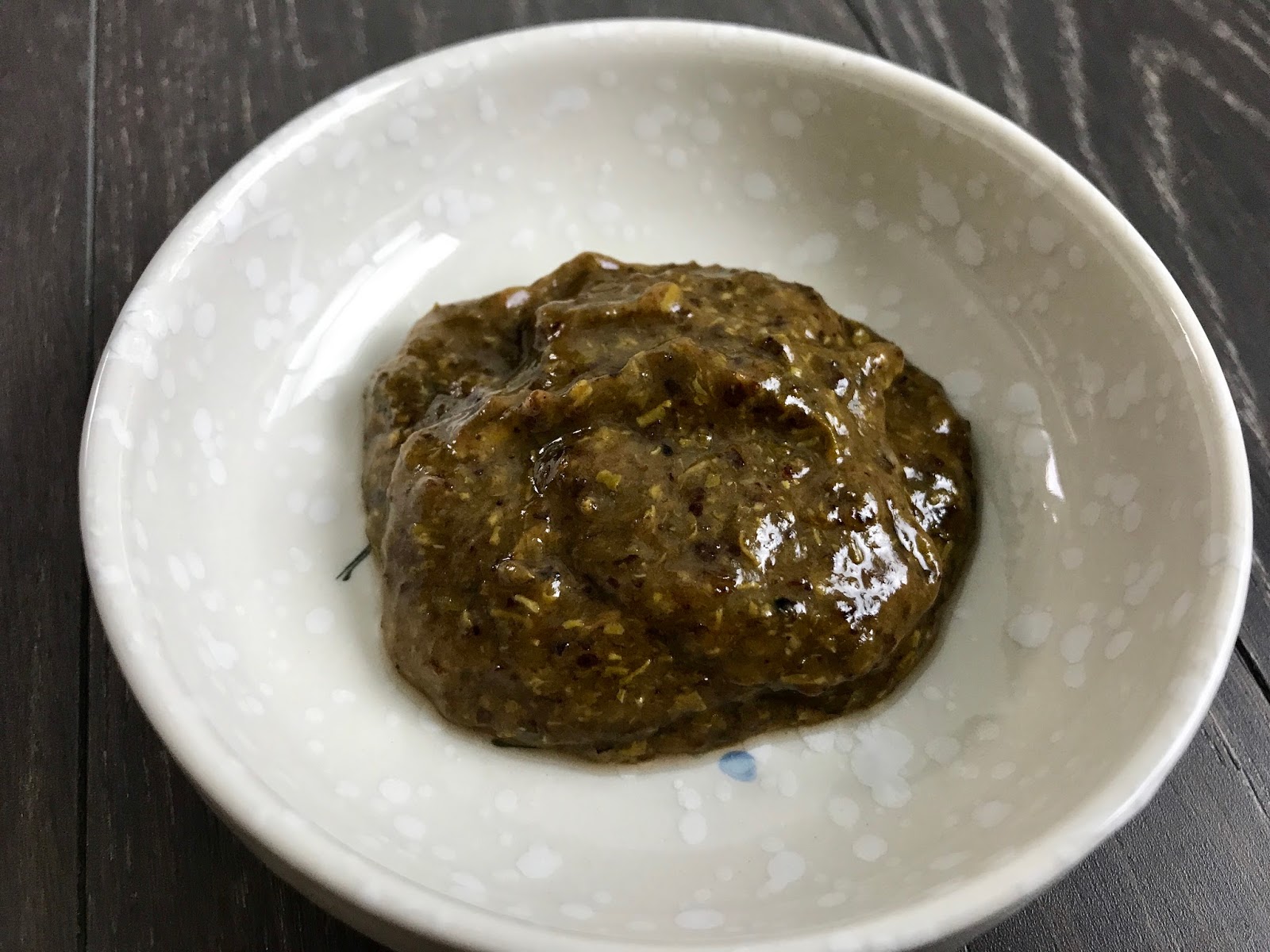
Since Japanese knotweed tastes tangy and sweet, I used it to make some knotweed jam for the yogurt dessert.


Japanese Knotweed Jam

Ingredients:
1/2 cup Young Knotweed Shoots
3 tablespoons Sugar
3 tablespoons Rum Raisin

I infused the raisin three years ago and I only use it for special dessert.  If you don't have some on hand, just use raisin and a splash of rum.  Or just omit the rum.


How to make:
1. Rinse the knotweed carefully; cut it into bite sized pieces.

2. In a non-stick pot, add the knotweed and a cup of water.  Bring it to a boil and cook continuously until the knotweed is totally soft and the liquid has almost evaporated. It takes about 5 minutes.

3. Pour the cooked knotweed in a blender, including the cooking liquid.  Add raisin.  Pulse until the mixture incorporates.


Japanese knotweed Jam


Da, da, da, da~

It is the dessert for tonight.  I must say it feels great to eat the food I forage or grow with my own hands.  There is a bond between the nature and the me inside.


Knotweed jam on greek yogurt, plus some hemp seeds and bean cracker for the garnish.


Roasted Butternut Squash Soup | 烤葫蘆南瓜湯

Compare to the non-roasted version, roasted butternut squash instead brings a tremendous different in the flavour.  The caramelized s...