Showing posts with label tea. Show all posts

Tuesday, February 25, 2020

Cider Tea


Cider contains vitamin C, good for boosting immune system or treating a cold, my husband and I always like to grab a handful of it and make a pot of cider tea beside a campfire whenever we go on a hike in winter.


INGREDIENTS:
Cider Leaves, fresh
Honey (optional)

DIRECTION:
1. Bring a pot of water to a boil. Put the cider in a tea cup. When the water comes to a rolling boil pour it over the cider. Let it steep for 10 minutes before enjoying it.


Monday, September 23, 2019

Sunday, November 12, 2017

Friday, July 14, 2017

Basic Steamed Rice|煮白米飯。甜米茶


A rice cooker is a very essential kitchen appliance for Hong Hong households.  I'd actually never known anyone who didn't have a rice cooker at home if they would ever cook at home.

My mom has always cooked rice in a rice cooker as long as I can remember, but she told me her family used to cook rice in a pot over a wood fire.

"People needed to squat in front of the stove while fanning the fire.  They needed to be very careful not to let the rice burn.  But of course, it happened sometimes," Mom laughed.

Mom grew up in China with my grandparents who I've never met.  They were farmers.  Like many others, they worked a small plot of land from the government to grow rice, sugarcane, and many sorts of vegetables.  After their harvest, they needed to pay a certain portion of rice back to the government as the rent.  "Farming was not a choice.  The government asked you to do it, then you had to do it!" she said.

"We didn't get white rice to eat often.  It was fancy, a luxury,"  She continued.  She explained that the crops often did not grow as well as they expected and they could barely meet their quota.    
"We were not starving like many unlucky people in the street, but yes, we never felt full.  To fill our stomach without eating too much rice, we added sweet potato into the rice and make congee.  It was cheap and filling.  Perhaps I ate sweet potato too much back then and now I rarely want it." Mom said with a light smile.

"So you never had normal white rice until you came to Hong Kong?" I asked.

"I did.  Your grandma would cook white rice during Chinese New Year.  Everyone would have a small bowl.  We would just hold the bowl in our hands, admiring the fluffy white rice and not really wanting to eat it.  When we ate it, we really savoured every grain of it," Mom said.

"Wow, it's not easy," I said, feeling myself very lucky.

"At home, your grandma and your aunt were responsible for cooking, and they didn't like me to hover around the kitchen while they worked so they would ask me to go outside to play with the neighbours.  I didn't need to cook until I met your dad and had you three," Mom continued.

"So you didn't learn how to cook rice the traditional way?" I asked.

"No. Honestly who will still use a pot to cook rice nowadays?  The rice cooker is clean and convenient, and you can forget about it after pressing the start button," Mom said, and started rinsing her rice for the dinner.

For years, I thought my mom was right about the evolution of the rice cooking method.  It wasn't until I went on a camping trip with my husband and my son years later, that I couldn't bring my rice cooker.  It was then that I discovered cooking rice in a pot is a true art.

We were making steamed rice for the sushi at the camp.  Funny to see we didn't even have a table and we needed to prepare food on a cooler.
I know many Canadian campers enjoy bringing hotdogs, burgers, or steaks on their camping trips.  Because these foods are convenient to cook and store.  But for Hongkongers, camping means a pot of instant noodles, a pot of rice with lap cheong (Chinese sausage) or even sushi.  My husband and I didn't want to eat any hot soup during the hot days, so we decided to make sushi.  Sushi needs rice, so I must cook the rice over the flame.

After reading many recipes, I came to the conclusion that a cup of rice to two and a half cups of water was the best recipe.  However, the rice was mushy on the outside and still hard in the core.  We had very unusual sushi for the camping supper that night.

The second time I tried to cook rice in a pot was learning to make pilaf with an Italian chef at culinary school.  I followed all the instructions carefully and was told that the pilaf looked fluffy and tasted great by my classmates.  But the chef disapproved of it.  "You Chinese only know how to cook rice in a rice cooker.  That's why your rice tastes awful, " he said.  Of course, I disagree with his generalization about Chinese and his manner toward me.  But this incident brought up the spark inside me that I wanted to prove him wrong.

A few weeks ago, my rice cooker broke down.  In that moment, not knowing what to do, I recalled a traditional Chinese recipe.  It is different than the many English versions of rice making and I found it is easier to work with.

Also, keep practicing is one of the keys.  I remember for the first few days, my husband and my son seriously complained about the rice.  "They are just not consistent.  Some part is mushy, and some part is hard.  How about I just get a new rice cooker?  Just take it easy." My husband even tried to lure me away from my rice experiments.  I insisted on using the pot.  I really wanted to master this traditional skill.

After a full week of practice, I finally learned the key to making fluffy rice.  Now I can proudly say to my husband that we don't need a new rice cooker.

Thanks for stopping by and reading my lengthy story.  I hope you find this recipe useful.


Basic Steamed Rice
1. Add the desired amount of rice in a pot. The pot should be deep enough that the water will not spill easily.

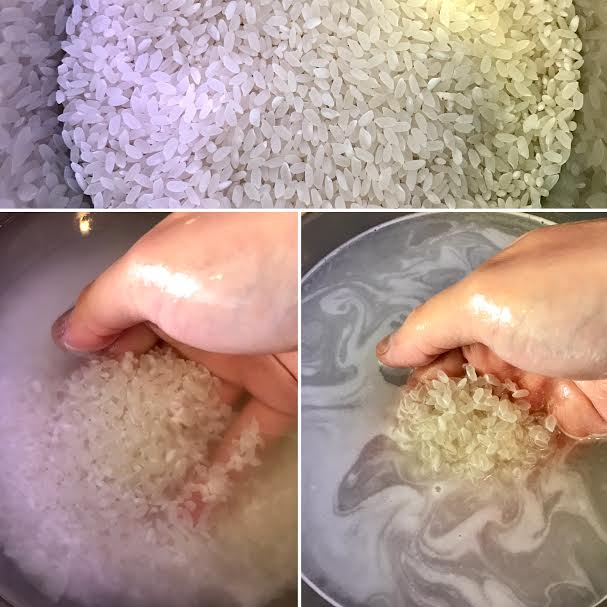
2. Rinse the rice a few times with a few changes of water until the water is clear.  The water won't be totally clear, but it should be clear enough to see through to the rice.

I was watering the radishes with the rinsed water.The first two changes of rinse water is actually packed with nutrition.  You can pour it over plants as extra plant food.


3. Stand a finger in the middle of the pot and fill the pot with water.  The level of the water should be double the level of the rice.


4. Bring the rice to a boil over high heat, uncovered, until the liquid is nearly absorbed; about 4-5 minutes. Stir it once during the process gently to prevent it from sticking.

5. Reduce the heat to low and cover the pot.  Continuously cook the rice for exactly 8 minutes.


6. Remove the rice from the heat and leave it for about 5-10 minutes without opening the lid.  The remaining heat and steam will help the rice prevent from sticking the bottom of the pot. Gently fluff the rice and the rice is ready.

You may find some crispy rice on the bottom (when you didn;t keep it aside for extra 5-10 minutes after it is done).  Don't waste it!  That crisp and hard rice is actually a wonderful ingredient for making a sweet rice tea that is commonly served in Korean restaurants.


Sweet Rice Tea


Ingredients:
Crispy cooked rice in the pot
1.5 cups of water
Sugar to taste


How to make:
1. Burn the rice without water over high heat until the rice turns lightly brown.  Don't over do it or the tea will be too bitter and it's unhealthy for consumption.


2. Add 1-2 cups of water to the pot.  Scrub the rice vigorously with a spoon.  Let the tea boil for another 30 seconds and then remove it from the heat.  Season the tea with sugar to taste.


Saturday, May 27, 2017

Mugwort - the wild edible and recipes |艾草食譜


Mugwort is an aromatic plant that grows widely across both cities and countryside.  If you learn to recognize them, you will be surprised how many of them actually are available around you.

I love the subtle sage-like flavour of mugwort.  Before I learnt foraging, I used to buy packs of dried mugwort leaves to make mochi (a type of Japanese glutenous sweet).  I thought mugwort was some plant that you need to get deep in the wood and normal people would not have the novelty to forage it.  So, after I learnt to recognize mugwort and started to spot them everywhere, I laughed at how silly I was spending money at the shop to buy mugwort.


Mugwort can grow more than six feet tall, and it has either pinkish flowers or light yellow flowers.  However, young mugwort is easy to overlook among other green plants.


Top on the left and underside on the right.


Mugwort’s leaves are greyish-green on the surface, and have sliver wooly hairs on the underside.  Also, some parts of the stem is purple in colour (I didn’t capture that in my photo).  When you rub it very close to the nose, you can smell a light sage-like scent.

Mugwort has an effect on stimulating blood flow around the uterus, and stimulate or ease menstruation.

SO PREGNANT WOMEN MUST NOT HAVE IT!

Many people said that mugwort can enhance vivid dreams.  I’m not sure about that because I always remember my dreams in the morning.  But putting a bunch of dried fragrant mugwort in the bedroom would be a nice idea.

For me, mugwort is a flavoring in dishes.  I use it in soup, dessert, or tea.


Mugwort Salmon Soup


Ingredients:
1 pc Salmon, cut in bite size
1 handful Fresh Mugwort, leaf part only
4 cups Water
1/2 cup Milk
Salt to taste


How to make:
1. In a pot, combine the water and milk.  Bring it to a boil.

2. Add salmon and mugwort.  Continuously boil until the liquid comes back to a rolling boil again. Reduce the heat to medium.

3. Skim off the foam.  Allow it to cook for another 5 minutes. Season it with salt.


Mugwort Panna Cotta


Ingredients:
1 cup Fresh Mugwort, leaf part only
3 cups Whole Milk
1/3 cup Sugar
8 gram Agar Agar
a small pinch of salt


How to make:
1. Combine all the ingredients in a pot.  Bring it to a boil. Reduce the heat to a simmer and let it simmer until the agar agar is totally dissolved; about 20 minutes.

2. Drain and discard the mugwort.  Divide the liquid evenly into the serving containers.  Chill until it is set.


Mugwort Evening Tea


Ingredients:
A small handful of Fresh Mugwort Leaves
Hot Water


How to make:
1. Bring a cup of water to a rolling boil.

2. In a cup, add the washed mugwort.  Pour in the hot water.  Let it steep for about 8 minutes.


Mugwort Mochi (Glutinous Rice Ball


Ingredients: for 4 mochi 
1 big handful of Fresh Mugwort, leaf part only
100 gram Glutinous Flour
150 ml Water
Corn Starch for coating
Red Bean Filling or any type of sweet filling


How to make:
1. To make the mugwort juice, combine the mugwort and water in a pot and bring it to a boil.  Then, reduce the heat to medium-low and boil it for another 5 minutes.  Turn off the heat and let it cool.

2. When the liquid is completely cool, blend it in a food processor. 
Drain and discard the mugwort leaves.  Measure the liquid; you will need about 150 ml for this recipe.  Adjust the liquid with water if it’s needed.


From left to right.

3. Add the glutinous flour into the liquid gradually and mix it with a spoon.  Make sure the mixture has no lump.

4. Cover the bowl with a lid.  Heat up the mixture in the microwave for 45 seconds.  Take it out.  Stir it vigorously with a spoon until it is sticky.  (It should be done in 10 seconds).  Cover the bowl again. Heat up the sticky mixture for another 40 seconds.  Take it out and stir it again.


From clockwise.

5. On a large plate, sprinkle a generous amount of corn starch.  Pour the sticky dough on it.  Coat both sides of the dough with cornstarch to prevent stickiness.  Stretch the dough flat and divide it into 4 equal portions.

6. Press down a piece of dough, and then put a spoonful of filling in the middle.  Wrap up four corners and place the mochi up-side-down.


Thursday, May 18, 2017

Horsetail - the wild edible | 馬尾草

Different stages of horsetails.


The medicinal plant that dates back millions of years when dinosaurs still existed.

Horsetail is a perennial plant and an invasive species that originated from temperate regions.  This plant produces two types of young shoots: fertile and vegetative shoots.  Every year, starting in early spring, this wild edible will appear in many watery areas.


Fertile shoots of the field horsetails.


The fertile shoots have brownish colour and appear asparagus like. They can be eaten raw or cooked.  Each node of the shoots contains water; it is juicy and with almost no taste when eaten raw.
However, after giving them a quick fry with some oil and garlic, these young shoots resemble the taste of the Asian dried daylily, which have a crunchy, slightly sweet and savoury aftertaste (recipe is below).  I personally prefer cooked young shoots.


A big patch of vegetative shoots (on the left). The confiler-like foliages started to grow from the stem (on the right).


Vegetative shoots emerge after fertile shoots, and usually are good from spring to early summer.  They have bright green conifer-like foliage growing around the stems. People consider vegetative shoots as a tonic rather than food due to the rich content of silica, diuretic, and minerals in them.  It is said to improve hair, nails, bones, bladder, and kidneys.  They can be dried and stored as tea leaves.

When gathering vegetative shoots, try to look for the green tops that are bright green with upward foliages.  These green tops can be dried to make beneficial tea.  It tastes somewhat similar to Japanese green tea (recipe below).  However, the green stalk and rihizom should be avoid for consumption since the enzymes inside can destroy Vitamin B1 and thiamine. Also, long-term alcohol users, people who are Vitamin B deficient, pregnant or nursing women should avoid using horsetail.  Personally, I drink horsetail tea only one or two times a week as a treat (it is really delicious) while trying to get the medical benefit from it, but I will not recommend to drink it more than that.


A colony of scouring rush besides a stream. It belongs to horsetail family.


Scouring rush belongs to the horsetail family.  It also has no leaves and no flowers.  In early spring, this plant will produce young shoots that bear lots of spores to reproduce.  Because of the roughness of this plant, people in the old time used it to polish their pots.  I haven’t yet tried this method myself, but I am planning to do it this summer when I go camping.


Stir fry Field Horsetail Shoots


Ingredients:
A handful of Field Horsetail fertile shoots
2 cloves Garlic, sliced
1 tablespoon Vegetable Oil
Salt to taste


How to make:
1. Peel off and discard the black papery rings around the stems. Rinse the shoots a few times to remove the sand and dirt.

2. Heat up the oil over medium high heat. Add garlic.  Fry it until slightly brown.  Add the shoots.  Continuously fry them until they are fragrant; about two minutes.

I tried them as a warm side dish or cold appetizer.  Both were tasty.


Field Horsetail Tea|馬尾草茶


Ingredients:
Horsetail Green Tops
Hot Water


How to make:
1. Carefully rinse the horsetail in water to remove the sand and dirt (they are quite dirty).

2. To dry the leaves, roughly cut them into 1–2 cm long.  Place them on parchment paper evenly.  Roast them in the oven at 220F until they are totally dried and be crumbled into pieces easily.  Store the leaves in a air-tight container.

3. To make the tea, bring a cup of water to a boil.  Add a tablespoon of tea leaves in a cup, then pour the hot water over it.  Let it steep for about 5–8 minutes.  Enjoy.


Monday, April 24, 2017

Dandelions are finally back (with dandelion recipes) | 蒲公英咖啡。蒲公英醃菜

 I’ve been waiting for dandelions to come back since the middle of last winter. The whole plant is delicious, but it was the roots I was longing for. Dandelion roots can be used to make tea that is nutritious and cafferine-free.

Dandelions start coming up around mid April and flower until early summer, but the best time to harvest the roots is in April when the young leaves are just starting to develop, before the plant blossoms. At that time, most of the nutrients that have been stored up for the winter are still in the plants. Finding a day after the rain to dig up the roots will lead to an easier harvesting since the soil is loosened.

At Easter, I spent nearly two hours in my in-law’s garden to dig out these “teasures” and they were both very happy that I cleaned up their “weeds”.
After separating the roots and the leaves, I cleaned them under running water a few times and made sure there was no dirt, debris, or other plants like moss mixed inside them.

      To make the tea is very simple:
  1. 1. Cut the roots into pea size. Place them on parchment paper. Roast them at 360F until they are totally dried out.
  2. 2. Grind the roasted roots into finer powder with a stone grinder (which was what I used) or a food processor. Keep the powder in an air-tight container and it can keep in good condition for up to six months.
  3. 3. Whenever you want to enjoy this beneficial drink, just brew it like the normal tea you would drink. My preference is 2 flat teaspoons to 1 cup of water. Bring the water to a rolling boil and then pour it into the root powder. Let it steep for about 8–10 minutes and it is ready. I like mine with a splash of milk and some sugar.

Dandelion Tea:


I also used the dandelion greens to make a kimchi dish. I used the young leaves here because they are less bitter and much more tender. For people like my family and I who have little tolerance for bitterness in food, mature dandelion leaves are just too much to handle.

Kimchi Dandelion:

Ingredients:
20 stalks Young Dandelions, green part only
2 teaspoons Salt
Seasoning:
2 teaspoons White Vinegar
1 tablespoon Sesame Oil
1 tablespoon White Sesame, toasted
¼ teaspoon Ginger, ground
1 teaspoon Red Chili Flakes
DIRECTION:
1. Combine salt and dandelion in a bowl; rib it evenly. Leave it for 2o minutes for the bitter water to come out.

2. Squeeze out as much water as you can. Then rinse the dandelion under running water. Squeeze out the excess water from the dandelion again.

3. Add the seasoning to the dandelion. Mix well and taste it. Adjust the seasoning if it is needed. Let it marinate for at least 30 minutes before serving. For the best flavour, leave it in the fridge overnight before use.

I enjoy eating this kimchi with a bowl of very warm rice.

Roasted Butternut Squash Soup | 烤葫蘆南瓜湯

Compare to the non-roasted version, roasted butternut squash instead brings a tremendous different in the flavour.  The caramelized s...