Showing posts with label perilla. Show all posts

Thursday, October 26, 2017

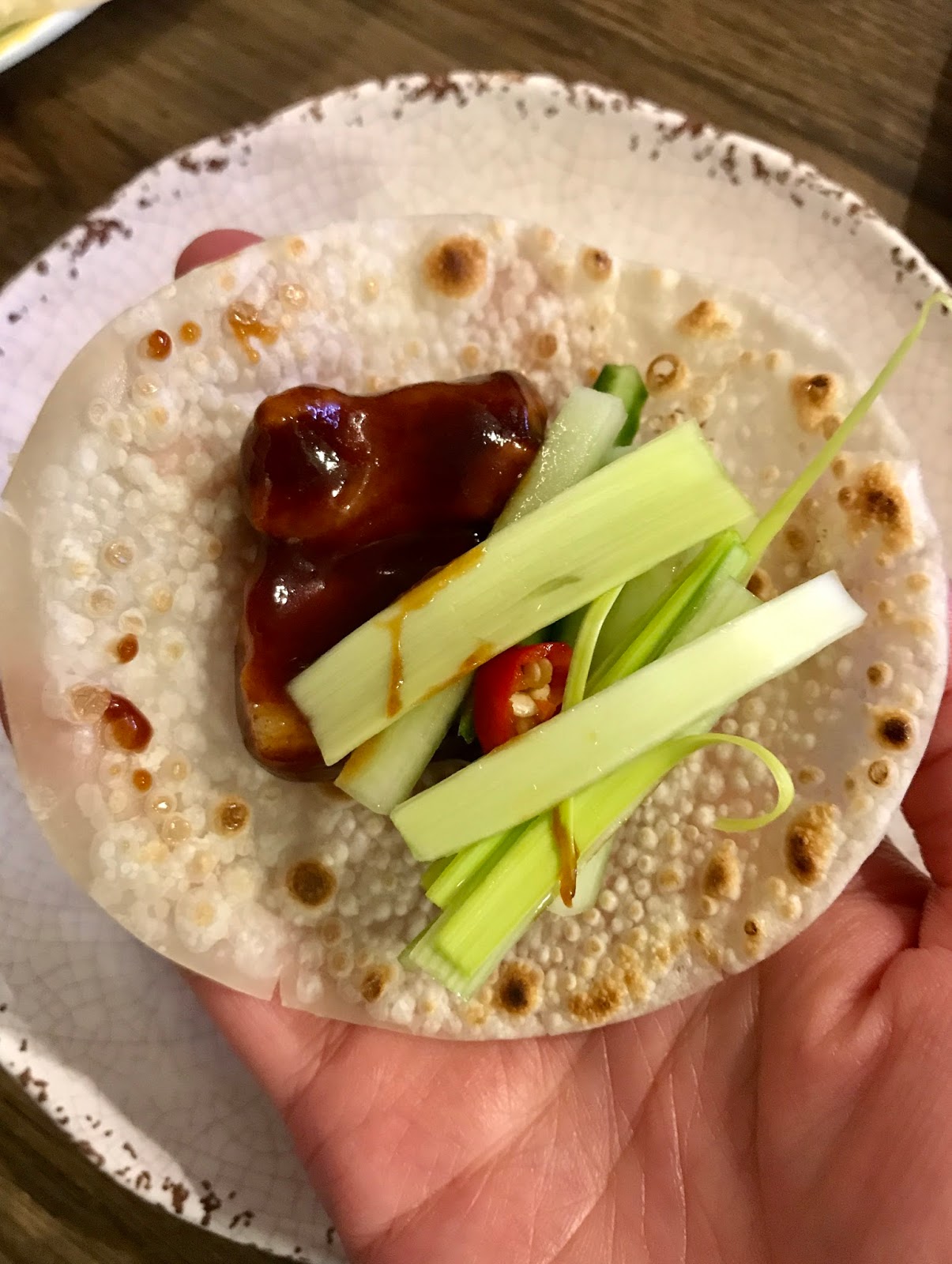
Pork Belly Wraps | 豬腩肉夾


This recipe is the pork belly version of Peking duck (barbecue duck) and I came up with it after dreaming about Peking duck the night before.

When I was a child, I would be so excited whenever my family was invited to a wedding.  Other than being able to play with my cousins, I was able to eat Peking duck, my favourite Chinese cuisine.

A server would push a cart in front of the table of guests.  On the cart, there were two ducks, a stack of bamboo steamers with many wrappers insiders, finely sliced scallion and leeks, chillies, and hoi sin sauce.  The staff then skillfully skinned around the duck, removed any extra fat that was attached to the skin while arranging the slices of skin on a plate piece by piece.  Finally, the staff will place the plate in the centre of the big table and put the rest of the condiments down for the guests to serve.  Usually each adult will share two servings and each child has one serving.  It is considered unthoughtful if you eat more than this portion.  So, you can see why I crave for Peking duck, right?

I know very well about the difference between duck and pork.  However, if you don't want to marinate and roast your own duck, pork belly is a very convenient ingredient to serve the purpose and I found fatty pork pairs with hoi sin sauce very well.

To wrap the meat, I chose wonton wrappers and perilla leaves.  One brings you substantial feeling and the other brings the fresh herby flavour.

Thanks for stopping by.  I hope you like this recipe.


Pork Belly Wraps | 豬腩肉夾


Ingredients:
1 lbs Pork Belly, skin on
10-15 pcs Perilla Leaves (can be found in Korean supermarket)
10-15 pcs Wonton Wrappers
1 Leek, white part only
1/2 Cucumber
1-2 Red Chill
1 bowl of Cooked Rice (optional)
1/3 cup Hoi Sin Sauce
White Pepper


How to make it:
1. Place the wonton wrappers on a dry pan.  Heat both sides on low heat until slightly brown.  Cover them and set them aside.


2. Rinse of the leek.  Cut the white part into slices and soak them in the water for about 5 minutes; drain well.

3. Cut the cucumber in half and remove the seeds.  Cut the cucumber into sticks.

4. Slice the red chilli; deseed it if desired.


5. Slice the pork belly into about 1/2 cm pieces.

6.  Bring a small pot of water to a boil over high heat.  Add the pork and white pepper.  Let it come to a boil again and cook for another 5 minutes.  Scoop out the foam on the top.  Drain the pork.


7. To serve, dip the pork belly in the hoi sin sauce and place it in the centre of the wonton wrap, followed with leeks and red chilli.


8. Or, you can add some rice with a perilla leaf.


Saturday, October 14, 2017

Perilla Leaf Kimchi |紫蘇葉泡菜


If you have ever visited a Korean supermarket, you probably have seen perilla leaves.  They are usually sold in bundles or in packages.  Perilla leaf is a common vegetable that belongs to the mint family, with a mild herby flavour somewhat similar to anise and basil; it is widely used in Korean cuisine as vegetable, kimchi, flavouring, or wrap.

Perilla leaf isn't usually found in Hong Kong cuisine, so I learnt this wonderful leaf late after I moved to downtown Toronto, where Korean cuisine is broadly embraced. 

Funny is that my first experience of perilla leaf wasn't a nice one.  I always noticed the herby note of these vivid green leaves, but I'd never realized how strong it could taste when putting the whole piece of leaf in the mouth, along with the hot rice or spicy marinade.  I remember I swallowed it down hard, followed by a full glass of water and a few bites of other side dishes.

After that, I tried to stay away from perilla leaves, but I still bought them whenever I go to the Korean supermarket, just because I was attracted to their beautiful look.  Once I have them, I have to cook them, right?  Through time, I learned to enjoy its distinct flavour and perilla leaf kimchi has become the Korean recipe I make most often and enjoy most by far.

Thanks for stopping by.  I hope you enjoy this recipe.


You can buy perilla leaves at Korean supermarkets.

Perilla leaves are available all year around, but their have much better leaves in summer.


Perilla Leaf Kimchi 
紫蘇葉泡菜
Kimchi


Ingredients:
15-20 pcs Perilla Leaves
2 tablespoons Glutinous Flour
1/2 cup Water
4 tablespoons Fish Sauce
2 tablespoons Red Chile Flakes
1 tablespoon Garlic, peeled and minced
1 tablespoon Ginger, peeled and minced


How to make it:
1. Rinse the perilla leaves under cold running water.  Drain and set them aside.


2. In a glass bowl, combine the glutinous rice with 1/2 cup of water.  Mix it well.  Microwave the mixture for about 30 seconds; stir well.  Then return it back to the microwave to heat it for another 25-30 seconds, or until the mixture become gluey.

Don't over heat it, otherwise the mixture will turn lumpy or harden and it will have to start over again.


3. Combine the rest of the ingredients except the perilla leaves into the glutinous mixture.  Stir it until it becomes chilli paste.

4. Spread 1-2 teaspoons of the chilli paste on a perilla leaf.  Then, place another perilla leaf on top, and spread the chilli paste on it again.  Repeat this process until you finish all the perilla leaves.

5. Store the perilla leaves in an air-tight container.  Leave it at room temperature for two days before serving it.  Transfer the rest to the fridge and it can keep up to 4 days.

6. To serve, wrap a small bite of rice with a perilla leaf, and then put the whole thing in the mouth.


Roasted Butternut Squash Soup | 烤葫蘆南瓜湯

Compare to the non-roasted version, roasted butternut squash instead brings a tremendous different in the flavour.  The caramelized s...